
Your store is autonomous for the customer who shops there: they walk in, pick, pay and leave, any hour of the day, depending on nobody. But what about your operation — is it still manual?
That’s the contradiction every autonomous micro market operator knows: the store sells 24 hours a day on its own, but managing it still means reports, spreadsheets and stock checks in front of a computer. The data exists — the platform records every sale, every replenishment, every customer — but reaching it means sitting down, opening the dashboard, and navigating to the right report. In the middle of an operating day (or of another job, since many operators have one), that rarely happens at the moment the decision needs to be made.
Rodrigo, who runs the Economarket autonomous micro market operation and joined our pilot, summed up the problem better than any slide deck:
“We live on information today, and information needs to be easy. If I have to stop in front of a computer every time I need to look something up, it takes too long — and it ends up being neglected.”
Information that’s hard to reach is information that gets neglected. And in autonomous retail, neglected information has a price.
The invisible cost of the postponed decision
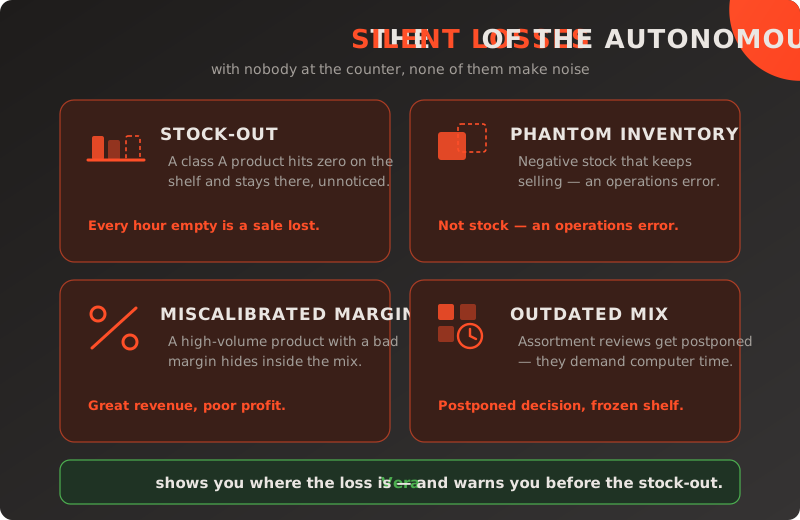
With nobody at the counter, an autonomous store’s problems make no noise:
- Stock-outs: a class A product — the one that drives revenue — hits zero on the shelf and stays there until someone notices. Every hour out of stock is a sale silently lost;
- Phantom inventory: products with a negative stock quantity that keep on selling. It’s the sign of an operational or data-entry error nobody has noticed — and, until it’s fixed, it distorts the store’s stock levels and replenishment;
- Poorly calibrated margins: a high-volume product with a bad margin hides in plain sight inside the mix;
- Outdated mix: assortment reviews get postponed because they demand computer time the operator doesn’t have.
None of these problems announce themselves. They have to be asked about. The question is: asked to whom?
Meet Vera
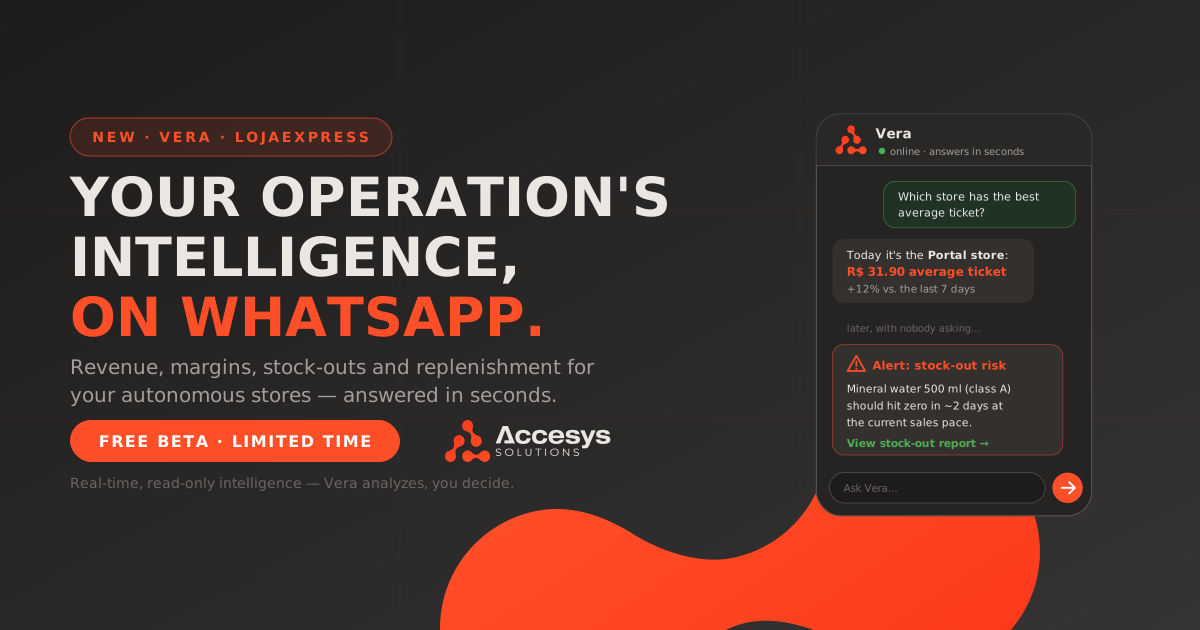
Vera is the Accesys artificial intelligence for operators on the LojaExpress platform. She lives where the operator already spends the day: on WhatsApp. Ask in plain language, the way you would ask a trusted store manager — and the answer arrives in seconds, built on your operation’s live data.
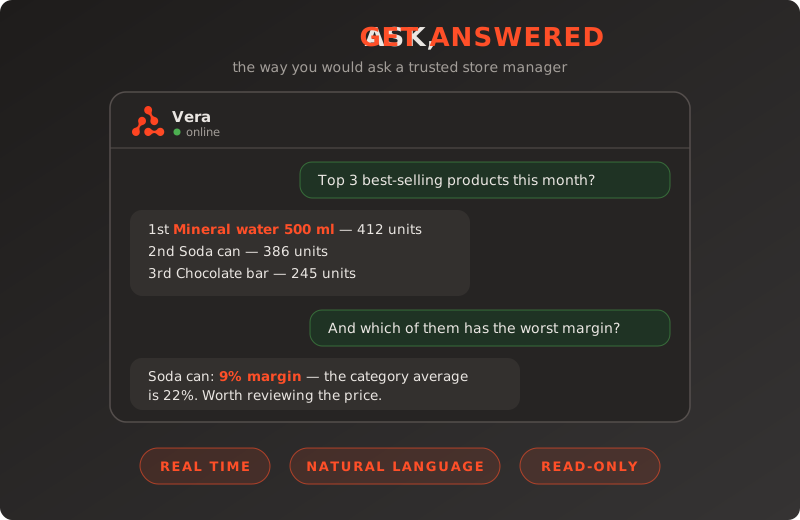
Real examples of questions Vera answers:
- “Which store has the best average ticket?”
- “What are my best-selling products in the last 30 days?”
- “What do I need to restock at the Portal store?”
- “Am I at risk of a stock-out?”
- “Which products have the worst margin?”
What Vera sees
Vera’s scope covers the whole operation:
- Sales and revenue — totals by period (today, 7 days, 30 days), average ticket, order count, period-over-period comparisons and store rankings: best ticket, highest revenue, most orders;
- Products and margin — best sellers by quantity or revenue, top-selling categories, markup, markdown and profit per product, best and worst margins, and single-product lookups (price, stock, attributes);
- Strategy — Pareto (ABC) analysis: which products generate 80% of revenue and where to focus to grow it;
- Stock and replenishment — what’s below the planogram minimum, class A products at risk of stock-out or already at zero, phantom inventory (Vera lists the products with negative stock that keep selling, so you can fix the operation) and suggestions on how much to restock;
- Operations — store status (online/offline), POS activity over the last 24 hours and the health of customer-recognition gateways;
- Orders and customers — order search by period, status, customer or product; order details; customer search and purchase history;
- Campaigns and coupons — active push campaigns and discount coupons, with values, conditions and usage.
She doesn’t wait for you to ask: proactive stock-out alerts
Everything described so far is the ask-and-answer mode. But Vera has a second mode, and it changes the nature of the product: she monitors your operation 24 hours a day and speaks up on her own when something important is about to happen.
Here’s how it works: Vera tracks the sales velocity of your class A products — the ones that carry your revenue — and projects when each will hit zero on the shelf. When she detects a stock-out risk, she sends an alert on WhatsApp on her own initiative, before the stock-out happens. The alert comes with a direct link to the stock-out report containing the data she analyzed, built on Pareto analysis: one tap and you review everything, decide and act.
In practice, it’s like gaining a new, proactive member of your team: someone who watches the system all day, every day, and pings you on WhatsApp exactly when it matters. You stay in charge of the decisions; Vera takes over the constant vigilance no operator can sustain alone.
Insight, not control: a security decision
One important point — and one we make sure to state clearly: Vera is read-only intelligence. She reads, analyzes and alerts, but does not execute actions in the system: she doesn’t create orders, change prices or edit records. Even the proactive alerts are exactly that — alerts: the one who decides and acts is always you.
That’s by design. The operator gains an analyst who is available all day and sees everything — and who, by design, can’t change anything. Each customer has their own WhatsApp group and isolated credentials: one operation’s data is never visible to another.
”The business is already in the palm of your hand”
The people who tested Vera describe her better than we do. From Rodrigo, of Economarket, an autonomous micro market operator in the pilot program:
“Sometimes we’d review the store’s product mix and had to bring the laptop to see how many units sold, whether it was worth keeping a product. Now you just ask: ‘how many sold in the last thirty days?’. The business is already in the palm of your hand.”
“I’ll be talking to her all day long, you can be sure of that — this information is very strategic for our business day to day.”
“Retail is very dynamic, it happens live. The way this helps… what a great tool, congratulations.”
Autonomous store, autonomous operation
Vera is more than a new feature: she is Accesys’s first step toward automating the retailer’s operation. The store is already autonomous for the people who shop in it; our goal is to make the operation as autonomous as the store.
The direction is clear: day-to-day operational management evolves into an AI agent, while the retailer focuses their time on strategic decisions — product mix, expansion, negotiation, customer experience. This is not about replacing people: it’s about lifting the operational burden off the shoulders of whoever carries the store today, with a team member who never sleeps and never lets anything slip.
The proactive stock-out alert is the first delivery of that vision — and it’s already live in the beta.
Free beta, for a limited time
Vera is in a free beta for a limited time for operators on the LojaExpress platform. Activation is handled by our team: no installation, no training, no new app — Vera joins your operation’s WhatsApp group and starts answering.
If you already run on LojaExpress, Vera is the missing piece of your daily routine. If you don’t yet, she is one more reason — alongside Accesys’s 40 years in retail technology and 1,000+ active stores — to get to know the platform.
Talk to an Operations Consultant and activate Vera for your operation.